Swiss milk, naturally!

Sustainable Swiss milk

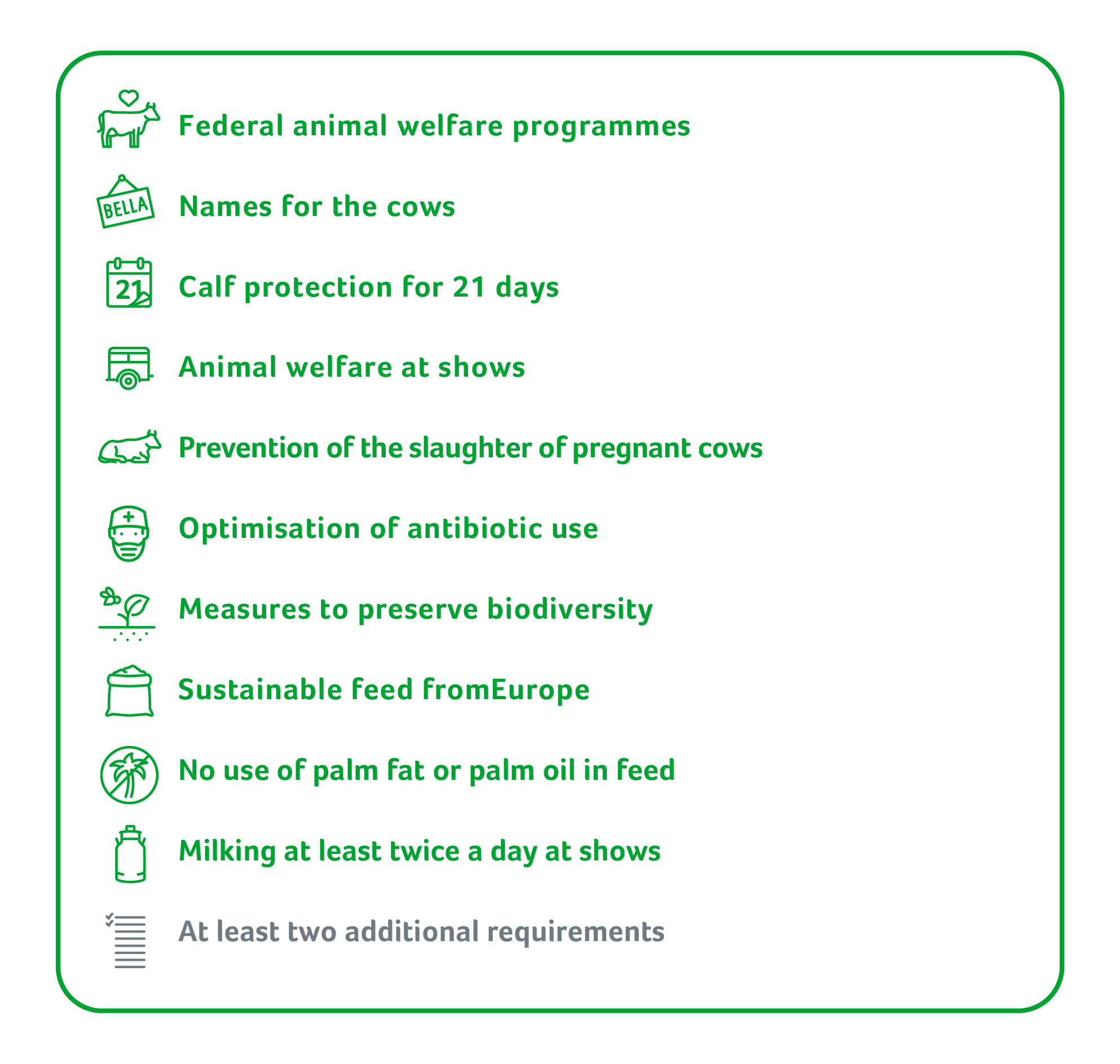
‘Swissmilk green’ represents the Swiss dairy industry’s commitment to sustainability, particularly in terms of animal welfare, feeding and social responsibility. To achieve its goals, it has introduced an industry standard with specific measures. This requires all milk producers to meet 12 requirements on their farms: ten basic requirements and at least two additional requirements from a selection. Since 2024, only Swiss milk that meets this standard can be traded or processed in Switzerland.

Yet another label? Really?

The answer is no. The industry standard bears the ‘swissmilk green’ logo. However, this is not a label, but a seal of quality that guarantees compliance with the industry standard. Unlike a label, the industry standard applies to all Swiss milk producers. So ‘swissmilk green’ symbolises the high quality of Swiss milk production.

10 basic requirements:

High standard of animal welfare

To ensure a high standard of animal welfare, at least one of the Swiss federal animal welfare programmes must be implemented: outdoor access on a regular basis (OARB), particularly animal-friendly housing systems (PAFHS), or pasture subsidy.

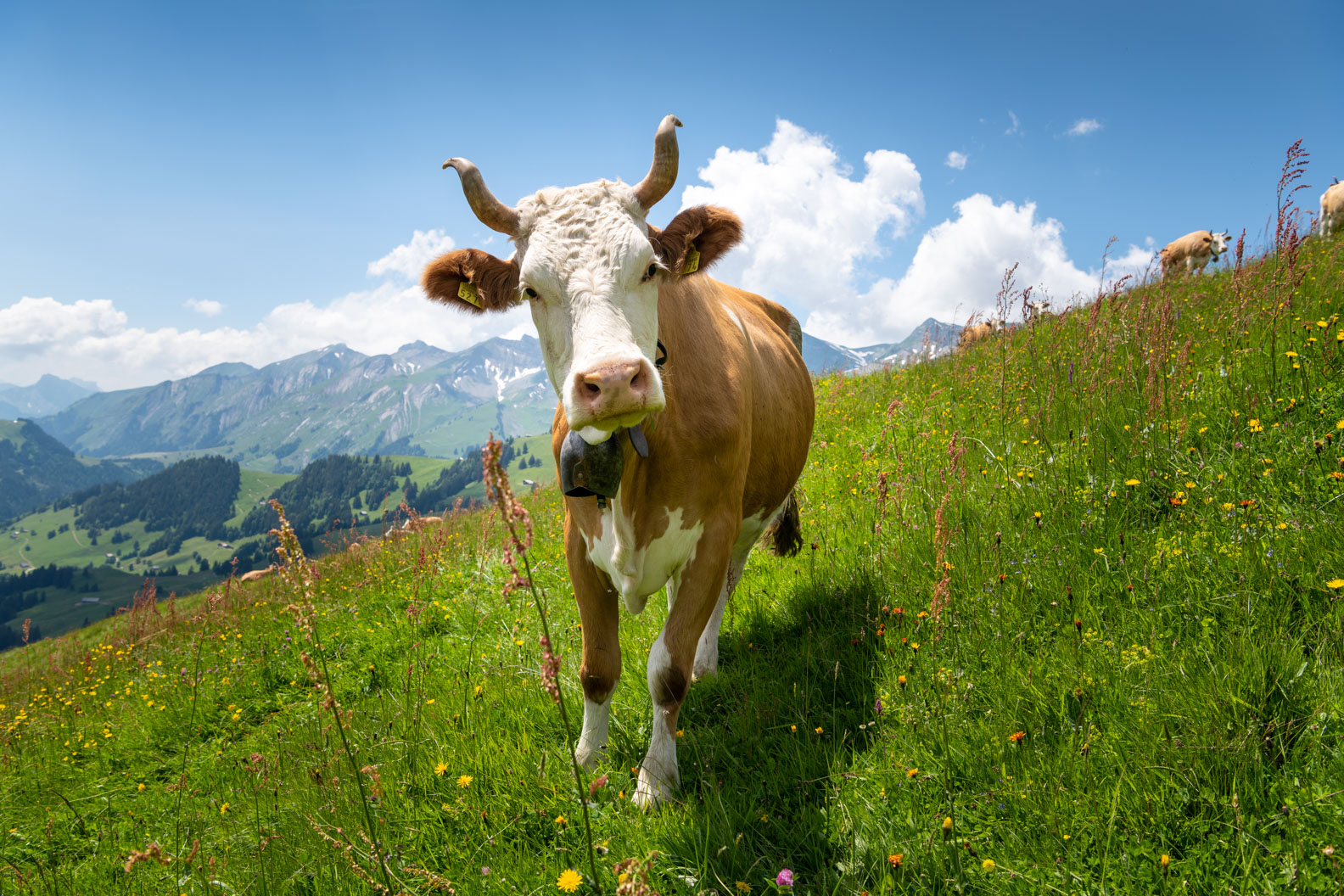
The OARB programme guarantees that animals get access to pasture on at least 26 days every month in summer. During the winter months, they can go outdoors on at least 13 days each month.
For participation in the PAFHS programme, multi-area housing systems, in which the animals live in groups, are mandatory. The animals must have opportunities for rest, exercise and activities, all of which must suit their natural behaviour. Lying areas and non-littered spaces must be accessible all day long.

The pasture subsidy programme stipulates that the animals must get access to pasture on at least 26 days in each month of summer. During the winter half of the year, the animals must get access to an outdoor space (yard or pasture) on 22 days each month. In addition, at least 70% of their feed must consist of pasturage.
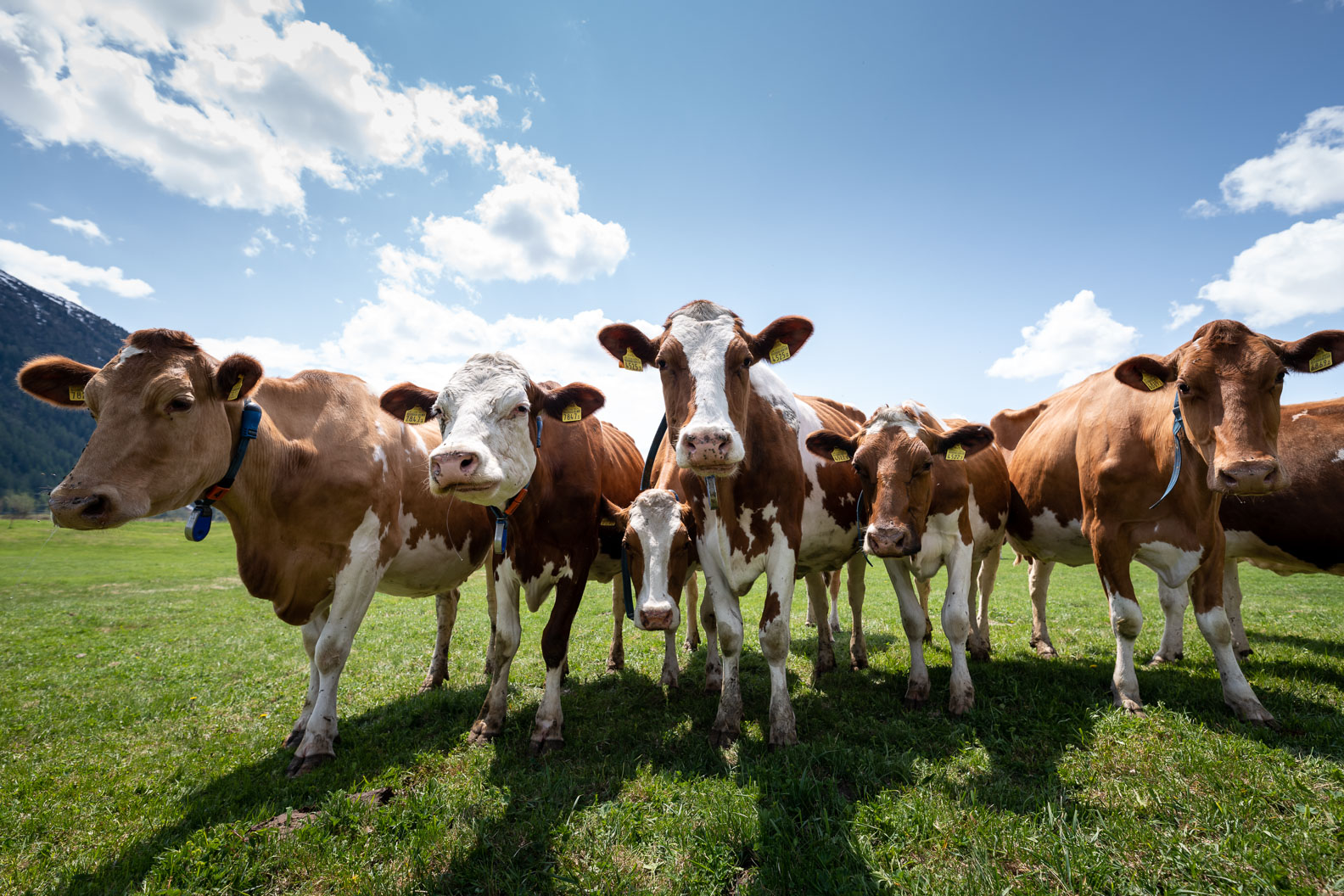
To ensure a high standard of animal welfare, at least one of the Swiss federal animal welfare programmes must be implemented: outdoor access on a regular basis (OARB), particularly animal-friendly housing systems (PAFHS), or pasture subsidy.

The OARB programme guarantees that animals get access to pasture on at least 26 days every month in summer. During the winter months, they can go outdoors on at least 13 days each month.
For participation in the PAFHS programme, multi-area housing systems, in which the animals live in groups, are mandatory. The animals must have opportunities for rest, exercise and activities, all of which must suit their natural behaviour. Lying areas and non-littered spaces must be accessible all day long.

The pasture subsidy programme stipulates that the animals must get access to pasture on at least 26 days in each month of summer. During the winter half of the year, the animals must get access to an outdoor space (yard or pasture) on 22 days each month. In addition, at least 70% of their feed must consist of pasturage.
Every cow has a name

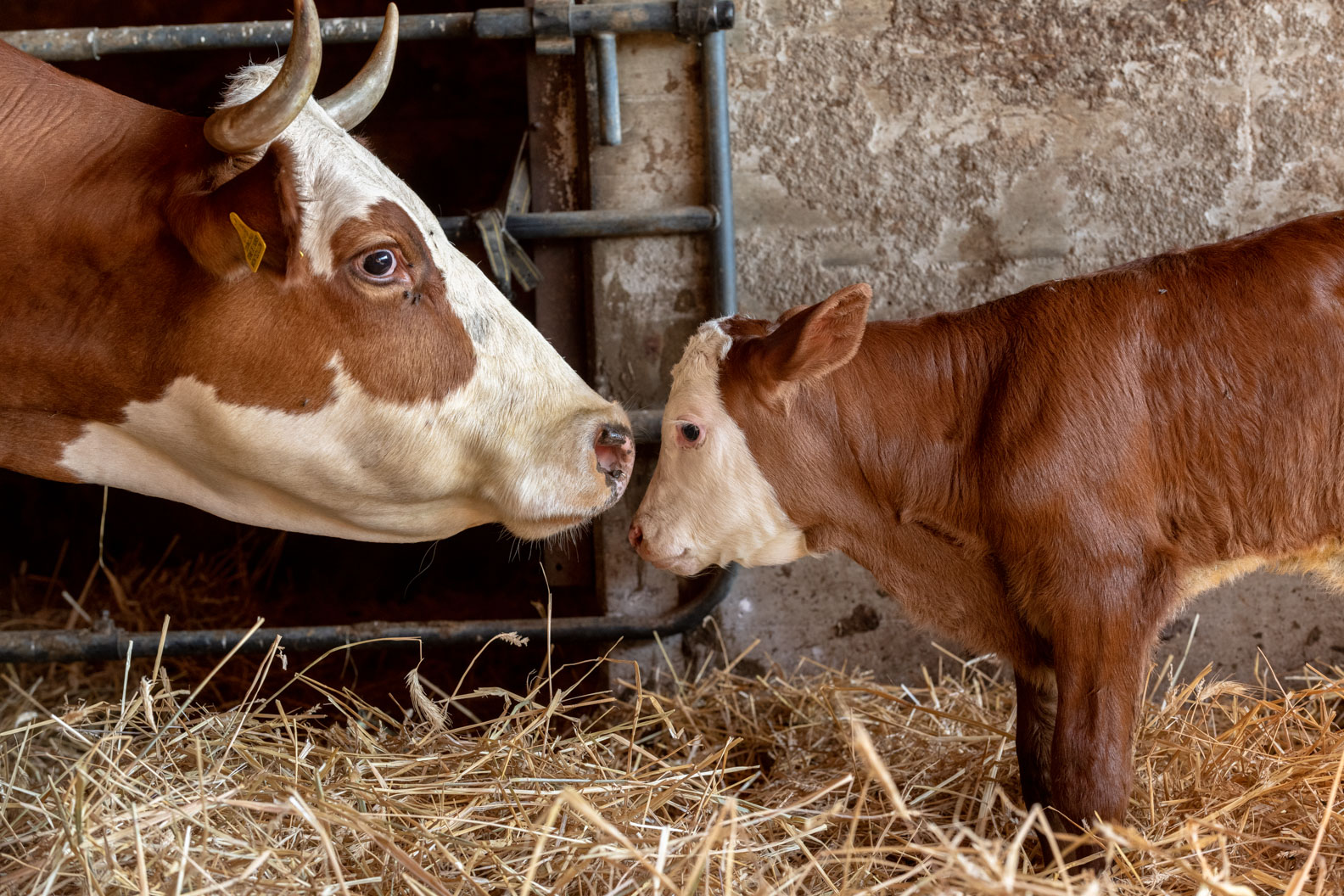
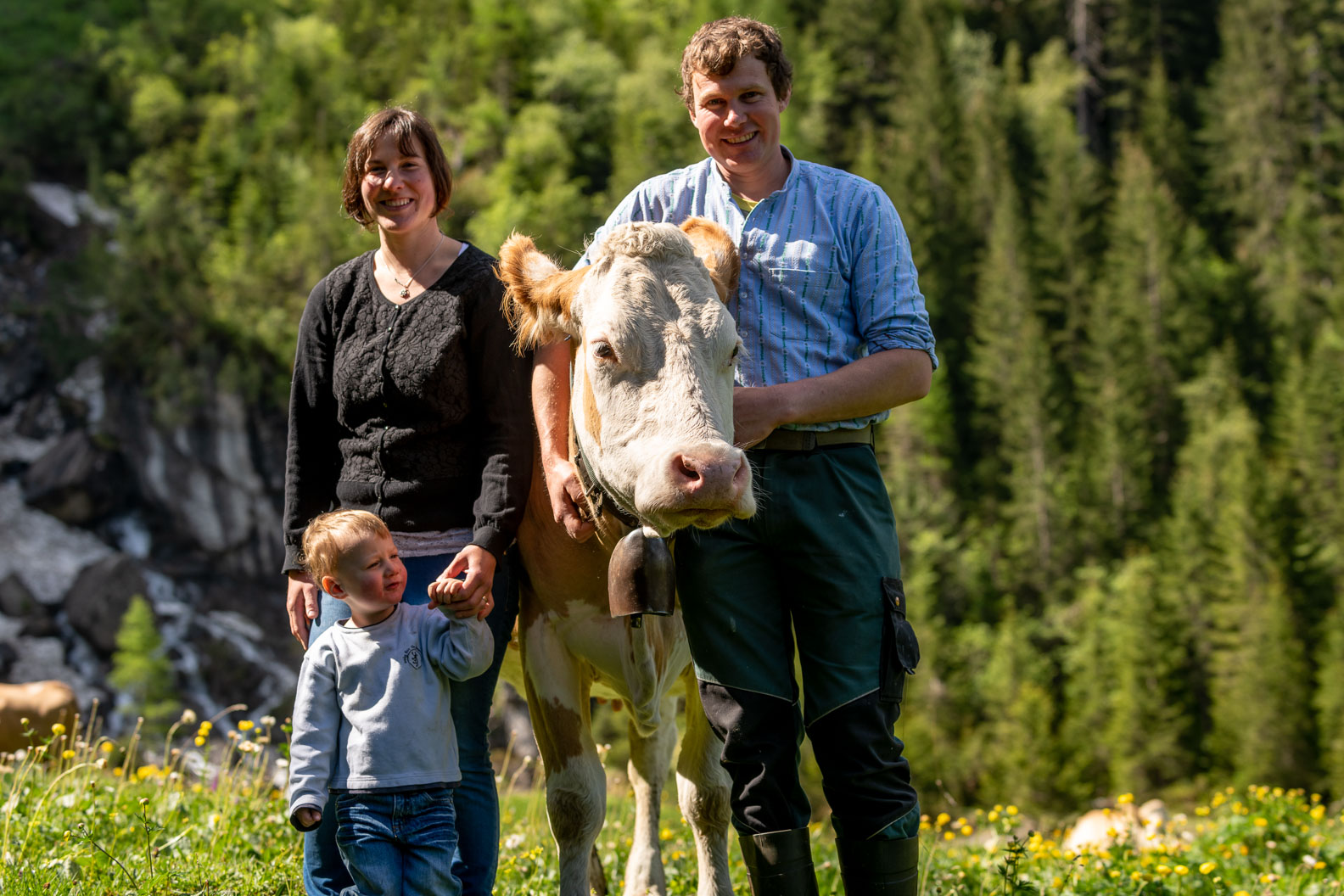
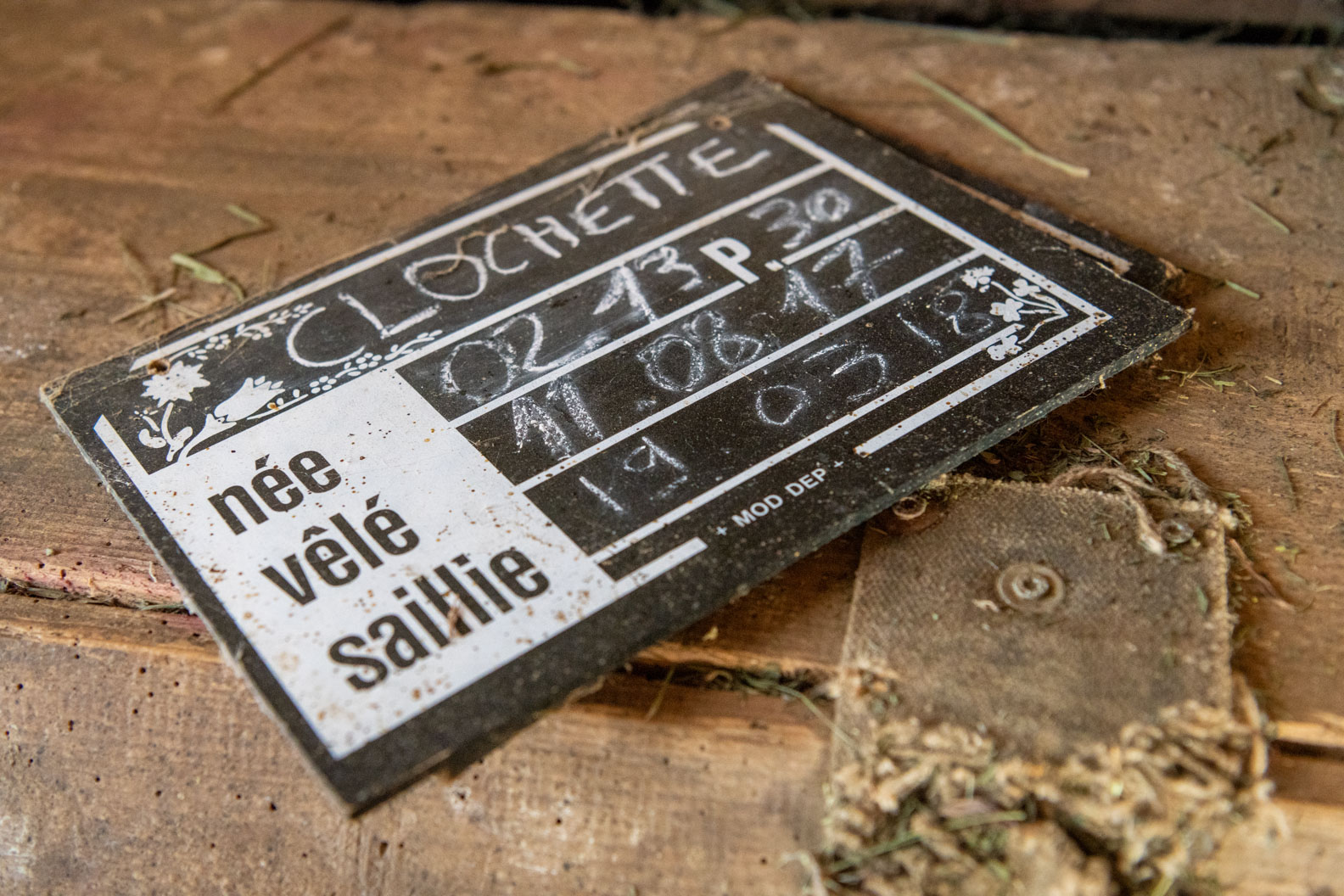
In Switzerland, cows must have a name and cannot be registered in the Animal Tracing Database under mere sequences of numbers or special characters. This practice reinforces appreciation and attachment with regard to the animals. The herd size on Swiss dairy farms is traditionally small, at 29 cows per farm on average. This allows milk producers to maintain a personal relationship with each animal.


In Switzerland, cows must have a name and cannot be registered in the Animal Tracing Database under mere sequences of numbers or special characters. This practice reinforces appreciation and attachment with regard to the animals. The herd size on Swiss dairy farms is traditionally small, at 29 cows per farm on average. This allows milk producers to maintain a personal relationship with each animal.


Young calves spend over three weeks gaining strength at home

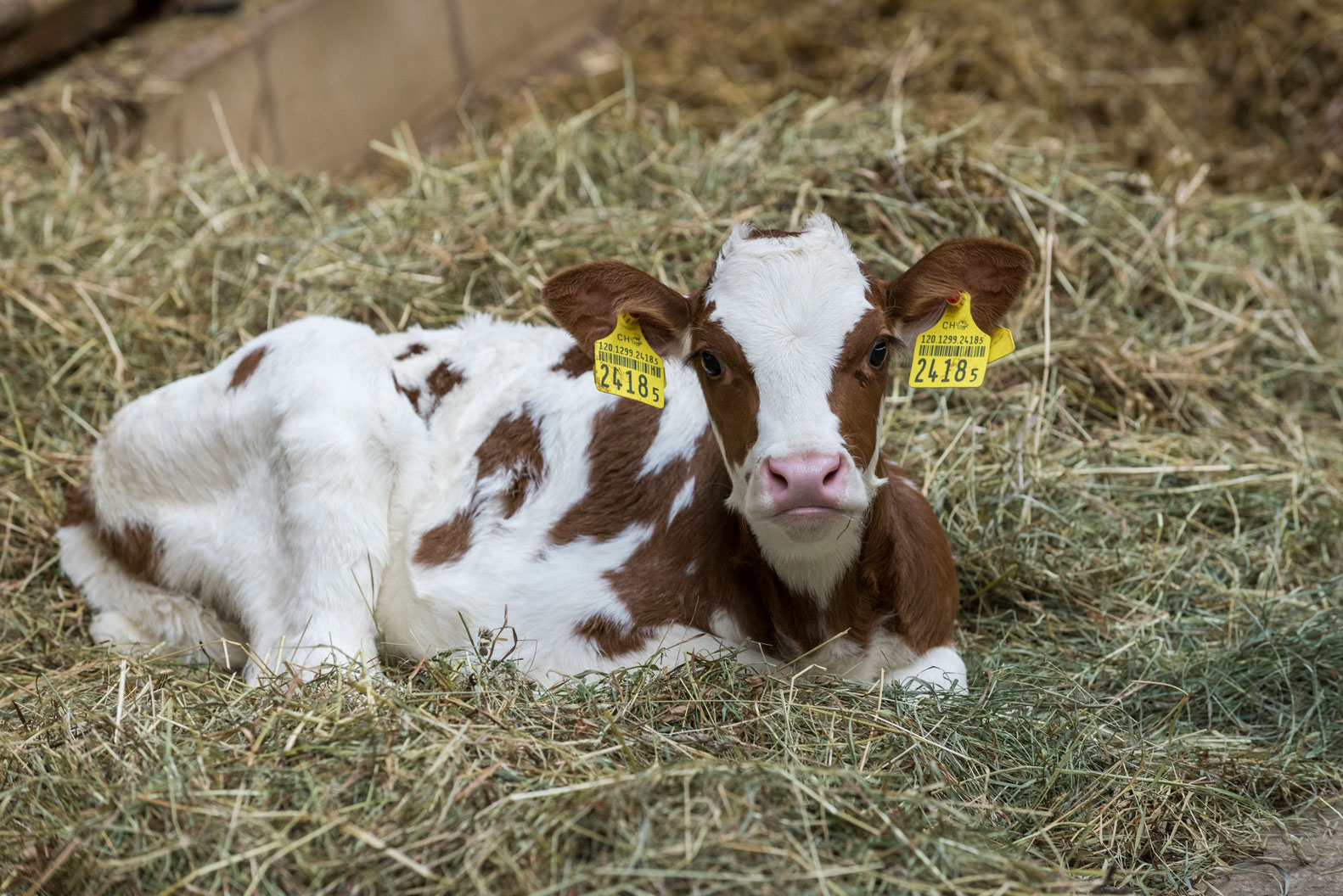
The first days after birth are crucial for a calf’s health and well-being. A good start in the first few weeks has a positive impact on later life. To ensure the best conditions in the first phase of life, calves must remain on their farm of birth for at least 21 days.

The first days after birth are crucial for a calf’s health and well-being. A good start in the first few weeks has a positive impact on later life. To ensure the best conditions in the first phase of life, calves must remain on their farm of birth for at least 21 days.

Strict rules for cattle shows

At cattle shows, the animals’ overall physical appearance is assessed. Participation in such shows is subject to strict requirements, the aim of which is to guarantee animal welfare at all times. Participants must comply with the show regulations issued by the Association of Swiss Cattle Breeders (ASR). In addition, the interval between milkings must not exceed 14 hours, so as to avoid painful overfilling of the udder.

At cattle shows, the animals’ overall physical appearance is assessed. Participation in such shows is subject to strict requirements, the aim of which is to guarantee animal welfare at all times. Participants must comply with the show regulations issued by the Association of Swiss Cattle Breeders (ASR). In addition, the interval between milkings must not exceed 14 hours, so as to avoid painful overfilling of the udder.

No slaughter of pregnant cows

Every slaughter must be as stress-free and pain-free as possible. The slaughter of pregnant animals is only allowed in absolute emergencies, e.g. in the event of serious accidents, because too little is known about when young animals in the womb begin to feel pain. Cows’ pregnancy status must be recorded in writing on the accompanying documents, so as to make sure that no pregnant cows are slaughtered. If in doubt, milk producers are obliged to arrange a pregnancy test.

Every slaughter must be as stress-free and pain-free as possible. The slaughter of pregnant animals is only allowed in absolute emergencies, e.g. in the event of serious accidents, because too little is known about when young animals in the womb begin to feel pain. Cows’ pregnancy status must be recorded in writing on the accompanying documents, so as to make sure that no pregnant cows are slaughtered. If in doubt, milk producers are obliged to arrange a pregnancy test.

Careful use of medication

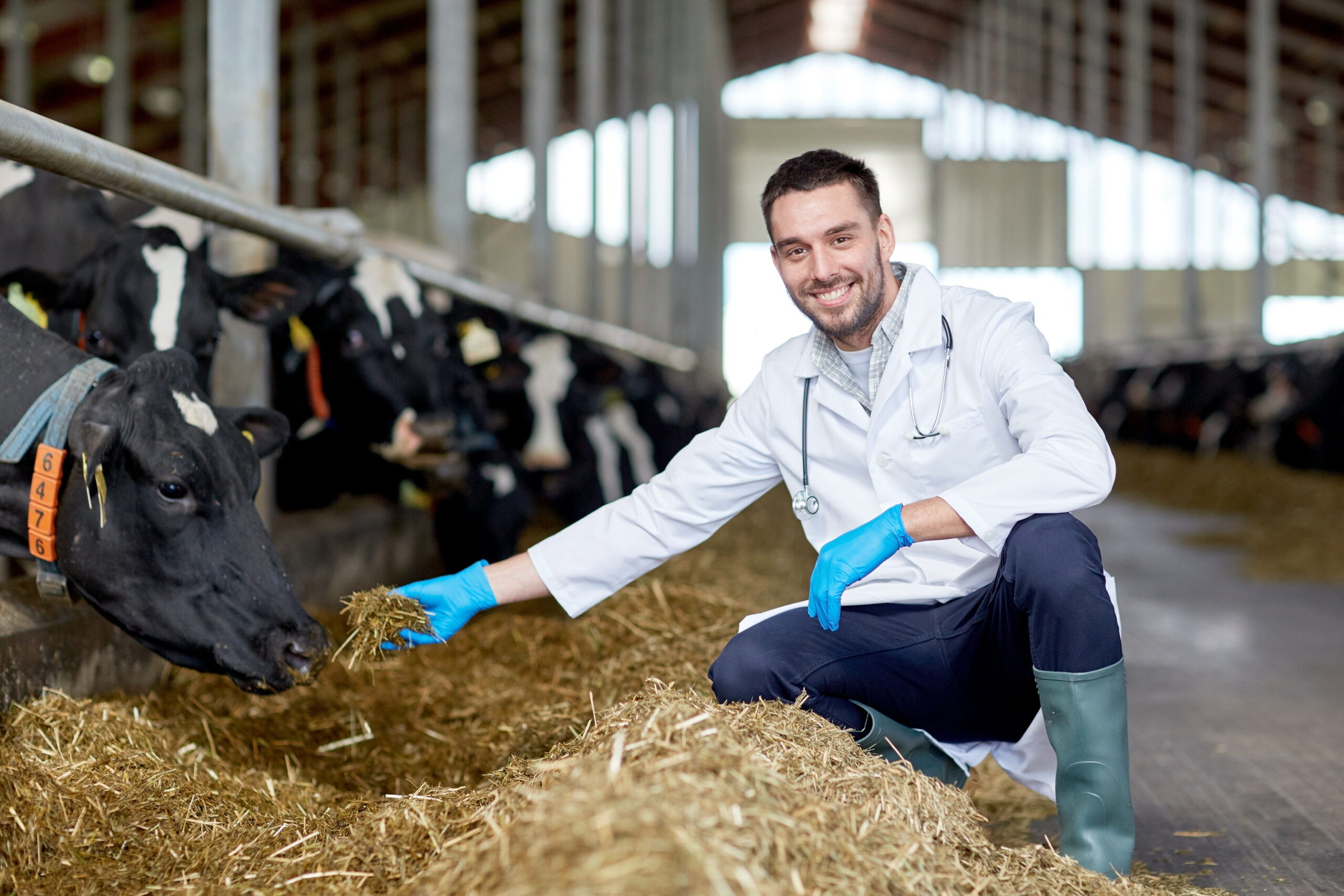
Clear regulations govern the medical care of our cows. Milk producers take great care to ensure that medication is used appropriately in each situation. Critical antibiotics are administered only in exceptional cases for specific purposes and must be prescribed by a veterinarian.

The use of antibiotics for livestock has declined by 50 percent over the last ten years. Since 2018, there has also been close cooperation with the association Kometian, whereby member farmers receive discounts on consultations about complementary medicine (e.g. homeopathy or herbal medicine), which avoids the use of antibiotics.

Clear regulations govern the medical care of our cows. Milk producers take great care to ensure that medication is used appropriately in each situation. Critical antibiotics are administered only in exceptional cases for specific purposes and must be prescribed by a veterinarian.

The use of antibiotics for livestock has declined by 50 percent over the last ten years. Since 2018, there has also been close cooperation with the association Kometian, whereby member farmers receive discounts on consultations about complementary medicine (e.g. homeopathy or herbal medicine), which avoids the use of antibiotics.

Protecting biodiversity

The ecological performance certificate (EPC) provides the basis for environmentally friendly agriculture. The EPC requirements are demanding and cover all aspects of sustainable production. They encompass animal-friendly housing, appropriate fertilisation and soil cultivation (crop rotation, soil protection), as well as ecological compensation areas. Strict adherence to these rules is one of the main reasons why the Swiss dairy industry excels when compared internationally.

The ecological performance certificate (EPC) provides the basis for environmentally friendly agriculture. The EPC requirements are demanding and cover all aspects of sustainable production. They encompass animal-friendly housing, appropriate fertilisation and soil cultivation (crop rotation, soil protection), as well as ecological compensation areas. Strict adherence to these rules is one of the main reasons why the Swiss dairy industry excels when compared internationally.

Sustainable feeding

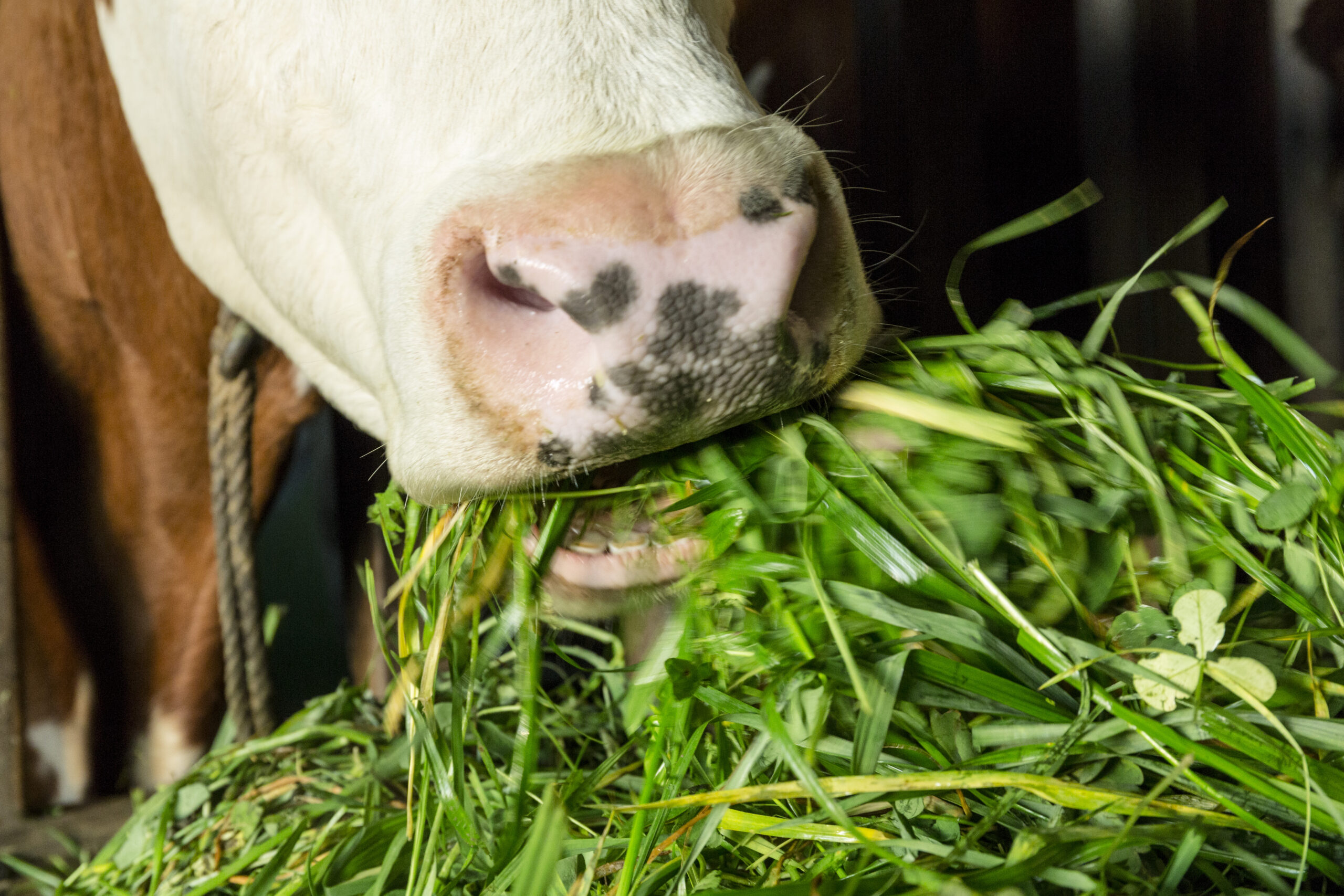
Those who feed protein-rich soya meal to dairy cattle must obtain it from sustainable, deforestation-free sources, thus utilising a by-product of soya bean oil production.

Those who feed protein-rich soya meal to dairy cattle must obtain it from sustainable, deforestation-free sources, thus utilising a by-product of soya bean oil production.

No palm oil, no palm fat

The ‘swissmilk green’ logo guarantees that dairy cows’ feed is free of palm oil and palm fat.

The ‘swissmilk green’ logo guarantees that dairy cows’ feed is free of palm oil and palm fat.

Milking for high milk quality

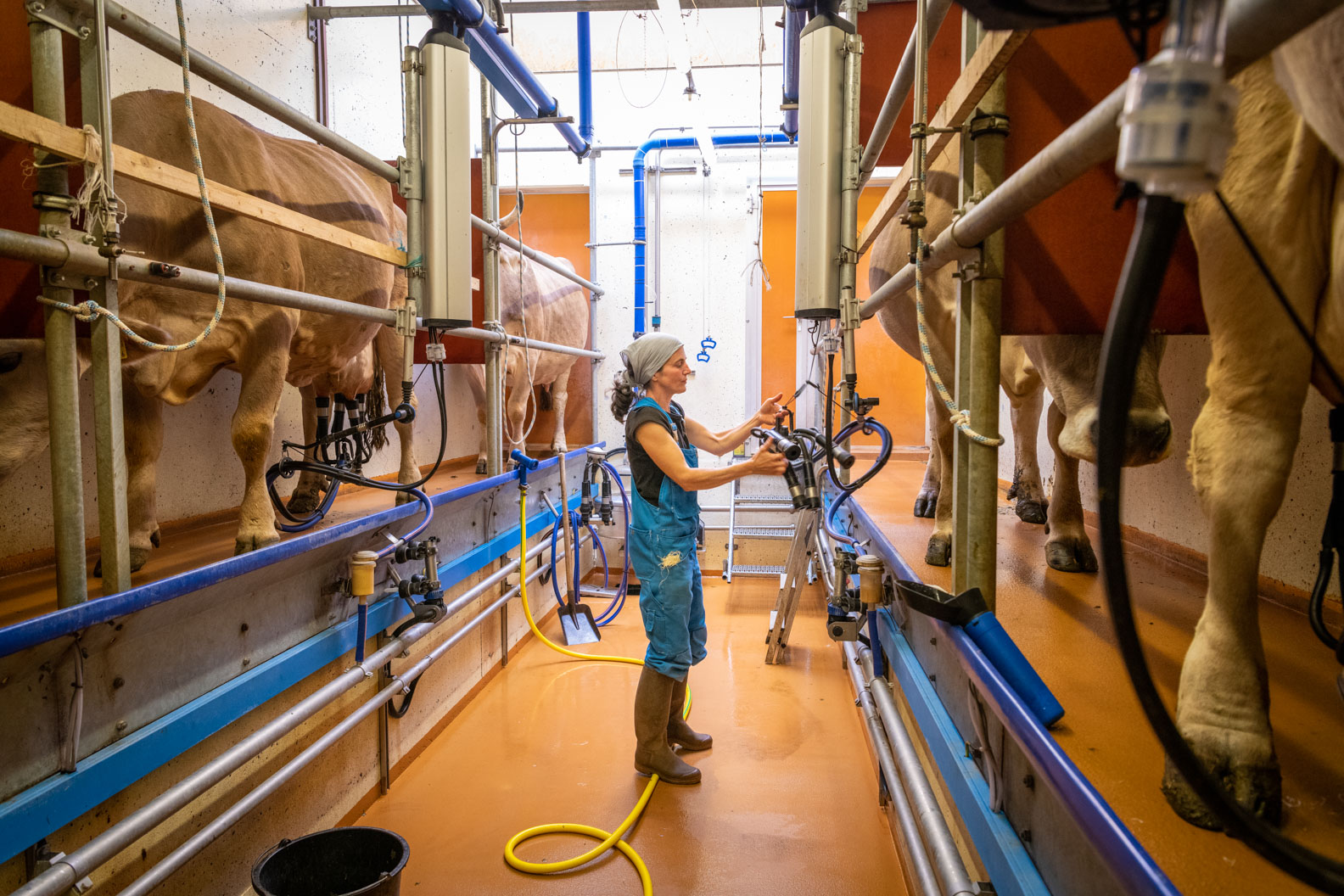
Proper milking, in harmony with the lactation cycle and using well-functioning milking equipment, prevents udder diseases, while also enhancing milk quality, milk yield, animal welfare and animal health.

Proper milking, in harmony with the lactation cycle and using well-functioning milking equipment, prevents udder diseases, while also enhancing milk quality, milk yield, animal welfare and animal health.

At least two additional requirements

Alongside the ten basic requirements, two additional requirements must also be met. Milk producers are free to choose these, purely based on the nature of their farm.


  • Two animal welfare programmes implemented

    A dairy farm can get top marks in terms of animal welfare by simultaneously implementing PAFHS and either OARB or the pasture subsidy programme for their dairy cows.

  • Methods from complementary medicine

    In order to find alternatives to antibiotics, animals are first treated using methods from complementary medicine. These include, for example: osteopathy, homeopathy and the use of medicinal plants.

  • Social security

    We really put our heart into our agriculture and food production. Many farms are run in the traditional way, as family businesses. Family members’ work is remunerated and documented, and social security contributions are paid.

  • Recognised training facility

    Agricultural work requires a great deal of know-how. It is important to train apprentices, so as to safeguard the continued existence of the industry. To be recognised as a training facility, a farm must have trained apprentices within the last three years.

  • Further training

    Farm managers or employees attend at least one half-day session of further agricultural training every year. This helps to ensure that our milk producers are familiar with the latest trends and scientific developments, and able to profitably integrate this know-how into production.

  • Public relations work on the farm

    Children should come into contact with agriculture at a young age and learn how their food is produced. Public relations work on the farm is important for passing on knowledge and values. At least one event for youths or children should be held each year.

Requirements for milk processors: audited sustainability management system

In order to be allowed to use the ‘swissmilk green’ seal of quality, milk processors also have to meet certain requirements.

As first purchasers of milk, they are responsible for ensuring that only milk that meets the industry standard is processed. The purchased milk and the sold (processed) milk are documented in a mass balance system, which is checked every two years.

Cheese factories must also have a sustainability management system, a recognised sustainability analysis system or a recognised self-analysis system in place. Environmental protection is promoted by taking the company’s ecological footprint into account.

In addition, cheese factories also have to provide evidence of compliance with the Swiss cheese industry code. Cheese bearing the ‘swissmilk green’ logo is made without any genetically modified rennet or artificial additives.

Good conditions for milk production on Swiss grassland

Swiss grassland offers ideal conditions for milk production: In Switzerland, 80% of agricultural land is grassland. Not only do we have a lot of grass, but thanks to proper cultivation, it is of high quality, making it an optimal staple feed for dairy cows. Thus, around 90% of the feed is domestically sourced and GMO-free (free from genetically modified organisms).

For sustainably produced Swiss milk

‘Swissmilk green’ represents milk produced in Switzerland, in a manner that is close to nature and sustainable. In terms of animal welfare, sustainability and social factors, the Swiss dairy industry is already characterised by strict requirements, compared to other countries. These requirements are made even stricter by the production standard. That is why milk producers are recompensed for their efforts with a sustainability bonus per litre of milk. This programme makes the Swiss milk sector organisation BO Milch a trailblazer for all other sectors in Swiss and international agriculture.